When to repair a boiler, and when to replace it
A boiler that has stopped once is not finished. A boiler that is leaking, losing pressure every week, or locking out through the winter often is. The useful question is whether a repair will hold, or whether you are paying to postpone a replacement. We say which one it is on the visit. We do not sell a part that will fail again next month.
Age is a clue, not a rule
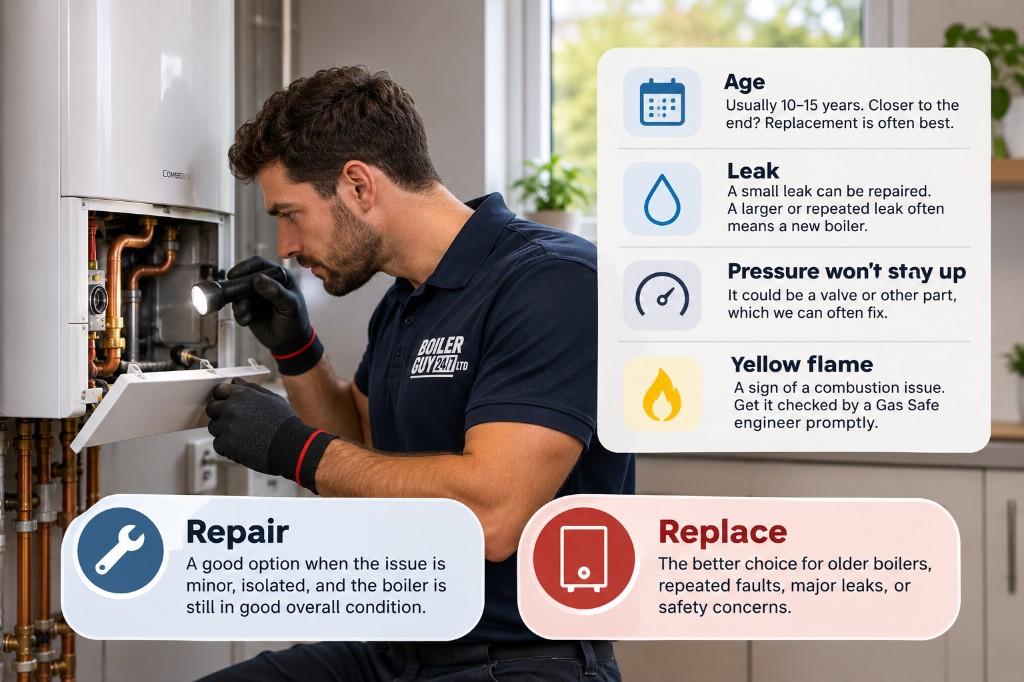
A lot of domestic boilers start to collect faults somewhere around 10 to 15 years. That is not a date we scrap them on. A boiler that has been serviced, and that fails once on a worn part, is often worth repairing. A boiler of that age that needs a second call-out in the same heating season, on top of its yearly service, is the one we talk about replacing.
In England and Wales, gas boilers installed in homes since April 2005 have had to be condensing boilers. If yours is older than that and still the original non-condensing unit, it is well into the years where parts and efficiency both go against it. The badge and the installation date tell us more than a guess from the hallway.
Faults that usually mean a repair
- One lockout, with a fault code, on a boiler that has otherwise been quiet
- A diverter or a sensor that has a straightforward replacement
- Radiators slow to warm because of sludge, which is a system problem, not always a dead boiler
- Pressure that dropped once after the radiators were bled
Banging or kettling can be scale or sludge in the system. It wants looking at. It does not, by itself, mean the boiler is scrap. We find the fault first. If a part and the age of the boiler make a repair the right job, that is what we do.
Faults that usually mean a replacement
- The same breakdown coming back inside a year
- Water leaking from the boiler itself, not a loose joint you can see on a pipe
- Pressure that falls again as soon as it is put back
- A heat exchanger or other major part on a boiler already past 10 to 15 years
A yellow or floppy flame, soot, or black or brown marks around the boiler are not a 'wait and see'. They can mean the gas is not burning properly. Turn the boiler off and have a Gas Safe engineer look at it before you use it again. Feeling unwell, with headaches, nausea, or dizziness, in a house where an appliance is burning badly is a reason to get out and get it checked, not to open a window and carry on.
If you smell gas
Smell of gas is separate from a repair-or-replace conversation. Call the National Gas Emergency Service on 0800 111 999 first. Where you can do so safely, turn the gas off, open windows, and keep away from switches and naked flames. Then call us on +44 7746 210558. A boiler that has been leaking gas is often replaced, but the first job is making the installation safe.